
Do not jump from alphabet to ragchew
The usual gap after a beginner course is too large: one character at a time in the trainer, then whole callsigns and words on the band. Bridge it deliberately. Copy two-character groups until both stay in memory, then three, then short words. The point is not just speed—it is learning not to panic when the next character arrives.
Random groups remove prediction
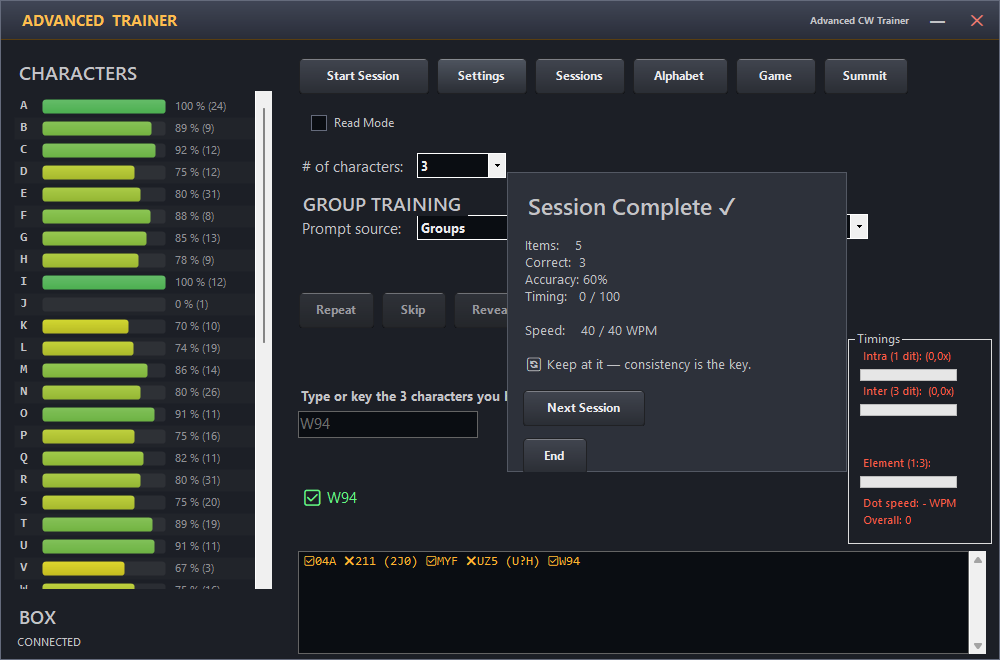
Random groups expose weak characters because context cannot rescue you. Start with groups of two or three at comfortable Farnsworth spacing. Increase the group length before you increase the element speed. Once five-character groups are solid, normal callsigns feel much less crowded.
Words build rhythm and head copy
Words let your brain recognise larger sound patterns. Begin with short, common words and amateur-radio abbreviations. Try to delay writing until the word or a short chunk has finished. That small act of memory is the start of head copy.
Callsigns are their own skill
Callsigns combine letters and numbers in unfamiliar patterns, often only once and under QRM. Train them separately. A MASTER.SCP-based list gives you realistic material; vary speed and tone so recognition is not tied to one perfect signal.
Use pressure without making every session a test
Morse Game turns recognition into a quick reaction task. Balloon Burst can use characters, groups, words or callsigns; missed targets stack up, so you learn to recover and continue instead of freezing after one error. Use it for variety, not as a replacement for calm, focused sessions.
A simple progression
- Two-character groups until you copy them without repeating each sound internally.
- Three- to five-character groups at the same character speed.
- Short words and common QSO abbreviations.
- Callsigns, first with generous spacing and then at normal timing.
- Alternate listening with paddle answers so sending develops with receiving.
The Advanced Trainer and Morse Game both run in the browser. The Windows suite adds the full set of training, analysis and competition tools.